I have a Search asset with a dynamic get variable called ids.
I want the URL: search_asset_webpath?ids=<id of data source record set, id of data source record set, etc> to return the values of %ds_surname% given the supplied asset ID’s in the query string.
You can’t use shadow record assets with a Search asset.
I’d recommend using a dynamic input (your GET variable) and passing that to the CSV data source’s record filter. Set up your asset listing to use the data source record set and then print your values using the %ds__surname% keyword.
You will need to pass the ids variable to the asset listing.
I’m actually trying to do something similar where I have an asseet listing with Replacement Root node for the listing (must be a child of the static root node) > source Get variable “filter”
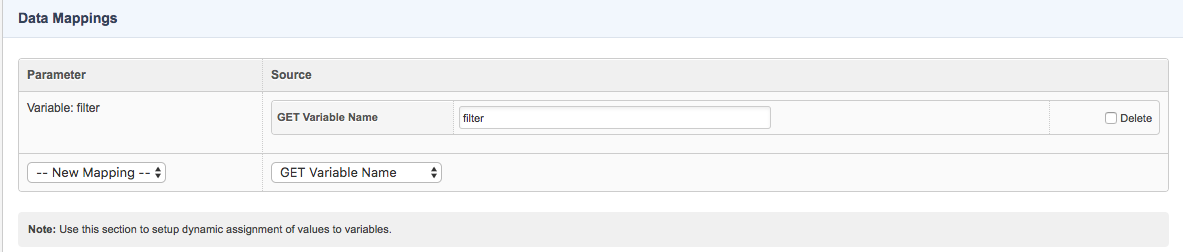
CSV data source dynamic input parameter filter > source get variable name filter
so when I try mysite.com.au/asset-listing?filter=12345:0,12345:1,12345:2 nothing gets filtered. Have I missed something?
I’m using the normal keywords %ds__title% etc in the default format.
No luck for me. Rather than a Search asset, I’ve now got an Asset Listing Page using a dynamic input GET variable on the CSV data source as suggested. It’s as if the asset_listing_page_webpath?ids=[values of GET variable] is ignoring the ?ids parameter. I wonder if this is still because the asset listing can’t see the CSV data source shadow assets.
You normally configure a data source record set to return information you expect to find in the data. So, you would filter the record set by passing the name of a suburb to the the asset listing via a GET variable. This then filters the data source record set to return data records matching that suburb.
In both cases, passing shadow asset IDs will not work (or, at least, I’ve never seen that done). This is the opposite of the intended usage.
Thanks for your time and efforts Hugh. I’ll resort to uploading an additional Id field in the CSV data source to match the shadow assets - this should then work Cheers
 Cheers